
Deployment
MCP vs API: Understanding Key Differences and Compliance Essentials
The Model Context Protocol (MCP) and Application Programming Interfaces (APIs) serve distinct roles in system integration. Understanding the protocol-level guarantees of MCP is critical for compliance with the 2026-07-28 specification.
Key takeaways
- 1.MCP is a strictly defined communication protocol focused on enforced predictability and consistent context management, distinct from the more flexible contractual nature of generic APIs.
- 2.The 2026-07-28 MCP specification introduces stringent requirements for statelessness, mandatory headers, and caching metadata, necessitating significant architectural adjustments for compliance.
- 3.MCP provides guaranteed interoperability, enhanced predictability, and simplified debugging in complex distributed systems due to its machine-verifiable compliance rules.
- 4.Migration from the 2025-11-25 to the 2026-07-28 MCP specification requires addressing breaking changes, particularly strict statelessness and new header mandates, to avoid system failures.
- 5.Tools like createmcps.com are crucial for continuous compliance checking, targeted rule validation, and strategic migration support, ensuring MCP servers adhere to the latest protocol standards and maximize operational resilience.
What is the fundamental difference between MCP and API?
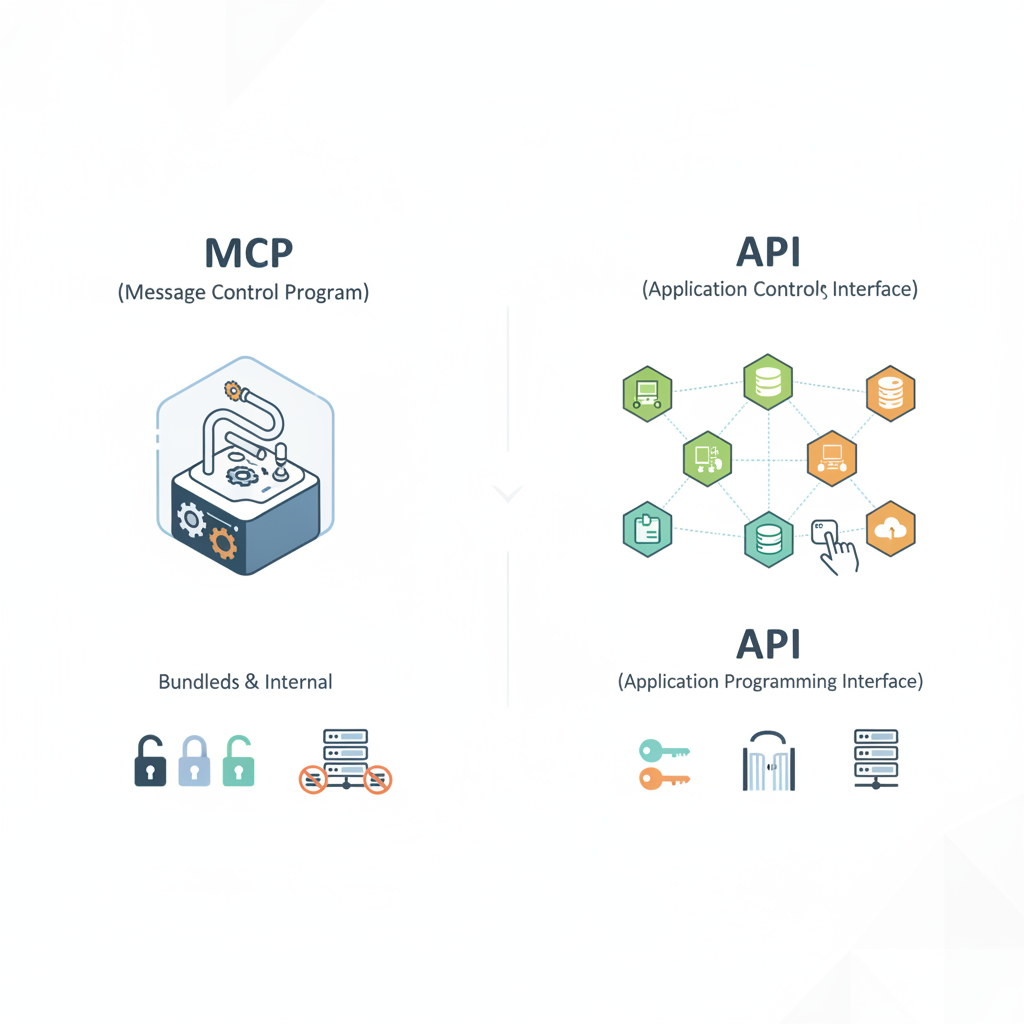
The fundamental difference between MCP (Model Context Protocol) and API (Application Programming Interface) lies in their level of enforcement and scope. MCP is a strict, machine-enforceable communication protocol designed for deterministic context management and guaranteed interoperability, especially under specifications like 2026-07-28. An API is a more generalized interface contract, outlining methods and data structures, but allowing more flexibility and interpretation in implementation, potentially leading to inconsistencies in complex distributed systems.

When discussing system integration and data exchange, the terms Model Context Protocol (MCP) and Application Programming Interface (API) are frequently used, often interchangeably, leading to significant architectural misunderstandings. However, MCP vs API represents a fundamental distinction between a strictly defined, machine-enforceable communication protocol and a more generalized interface contract. The Model Context Protocol (MCP) is a specialized communication protocol designed to establish and manage shared contextual models between distributed systems, ensuring deterministic state management and interoperability. This critical difference becomes particularly pronounced when adhering to the stringent requirements of the 2026-07-28 MCP specification, where protocol-level compliance is not merely a guideline but a foundational necessity for robust, predictable, and scalable server operations. Failing to recognize MCP as a protocol, rather than just another API, risks non-compliance and introduces systemic fragility.
The Fundamental Distinction: Protocol vs. Interface
The core of understanding MCP server design, particularly under the demanding 2026-07-28 specification, lies in recognizing that a protocol and an API operate at fundamentally different levels of abstraction and enforcement. An Application Programming Interface (API) is essentially a set of definitions and protocols for building and integrating application software. It specifies how software components should interact, often outlining methods, data formats, and conventions. APIs are contracts, but their enforcement is largely left to the implementer and the consumer, often through documentation and example. While robust, an API's adherence can vary, leading to 'API drift' where implementations subtly diverge over time.
In contrast, a protocol, such as the Model Context Protocol (MCP), is a formal system of rules that governs the format and transmission of data between devices. Protocols define not just the 'what' (data structures, operations) but the 'how' and 'when' of communication, including state transitions, error handling, and message sequencing. This strict definitional boundary means that protocol compliance is binary: either a system adheres to the protocol's rules, or it does not communicate effectively within that protocol's ecosystem. Alexis Johnson, an MCP Compliance Specialist with a background in server architecture, emphasizes that "the shift in the 2026-07-28 specification from implied conventions to explicit, enforceable protocol rules is a game-changer for system predictability and security." This expert perspective highlights that MCP mandates specific behaviors and responses at a foundational level, ensuring a consistent operational environment that generic APIs cannot inherently provide.
The distinction is not merely semantic; it dictates the level of predictability, interoperability, and testability achievable in complex distributed systems. APIs offer flexibility and abstraction, allowing developers to interact with services without needing to understand their internal workings. However, this flexibility can come at the cost of strict behavioral guarantees. Protocols, by their nature, prioritize deterministic behavior and interoperability, sacrificing some flexibility for rigorous adherence to a predefined communication standard. This makes protocols particularly suitable for environments where consistency and verifiable compliance are paramount, such as regulated industries or large-scale enterprise integrations where subtle behavioral differences can cascade into significant system failures.
Historically, the evolution of software development has seen a continuum from highly coupled, monolithic systems to loosely coupled, service-oriented architectures, often powered by APIs. While APIs have undoubtedly accelerated innovation and integration, the growing complexity of these interconnected systems reveals their limitations regarding true, machine-verifiable interoperability. The rise of protocols like MCP signifies a re-emphasis on foundational communication integrity, moving beyond mere interface contracts to enforce a holistic understanding of context and state across disparate services. This ensures that when a server claims to be an MCP server, it adheres to a universally understood and verifiable set of behaviors, rather than just exposing a set of functions.
Anatomy of an API: Flexibility and Challenges
Application Programming Interfaces (APIs) have become the backbone of modern software development, enabling disparate systems to communicate and share functionality. They define the methods and data structures developers can use to interact with a service. While incredibly powerful, the inherent flexibility and varied interpretations of API design patterns present unique challenges, particularly when strict, predictable behavior is a non-negotiable requirement.
REST APIs: Ubiquity and Inherent Looseness
Representational State Transfer (REST) is arguably the most prevalent architectural style for APIs, known for its statelessness, client-server separation, and use of standard HTTP methods. REST APIs are widely adopted due to their simplicity and adherence to well-understood web standards. However, REST is an architectural style, not a strict protocol. This means that while it provides guiding principles, the actual implementation details, error handling, authentication mechanisms, and even the definition of "resources" can vary significantly from one API to another. A study by ProgrammableWeb in 2023 indicated over 30,000 public APIs, with the vast majority being RESTful or HTTP-based (Source: ProgrammableWeb, 2023). This sheer volume underscores the utility but also the potential for divergence.
The "looseness" of REST, while enabling flexibility, can lead to interoperability headaches. Developers consuming a REST API must meticulously read documentation, handle diverse error codes, and often implement custom logic to deal with slight variations in resource representation or state management. This is where the distinction between an API and a protocol like MCP becomes critical; MCP aims to eliminate these ambiguities by enforcing a highly specific, machine-verifiable contract for every aspect of interaction, reducing the burden on consumers to interpret varied implementations.
GraphQL and gRPC: Specialization with Contractual Freedom
Beyond REST, other API paradigms like GraphQL and gRPC offer specialized advantages. GraphQL allows clients to request exactly the data they need, minimizing over-fetching and under-fetching. gRPC, utilizing Protocol Buffers, offers high-performance, language-agnostic communication, often favored in microservices architectures. Both provide stronger contracts than typical REST APIs through schema definitions (GraphQL Schema Definition Language) or interface definition languages (IDLs for gRPC). These contracts improve developer experience and ensure type safety.
However, even with these advancements, GraphQL and gRPC primarily define the interface and data transfer mechanisms. They do not inherently dictate the overarching behavioral guarantees, statelessness, or caching metadata requirements at the comprehensive system level that a protocol like MCP does. For instance, while gRPC ensures strongly typed message exchange, the server's broader adherence to context management or specific authorization flows remains largely an implementation detail, not a protocol-enforced characteristic. This means that while the data exchange might be highly structured, the contextual interaction around that data can still be inconsistent across different services.
The Challenge of API Compliance at Scale
At scale, maintaining consistent behavior across numerous APIs, especially when developed by different teams or third parties, becomes a significant challenge. Without a universal, machine-enforceable protocol, ensuring that every API adheres to enterprise-wide standards for security, performance, and data integrity is an arduous task. The cost of API integration and maintenance is substantial; a 2022 survey found that organizations spend an average of 10-15% of their IT budget on API-related activities (Source: IDC Research, 2022). A significant portion of this cost can be attributed to debugging interoperability issues arising from subtle API inconsistencies.
This is precisely the gap that MCP aims to fill. By defining a protocol that dictates not just the interface but the entire context management and interaction lifecycle, it provides a higher level of assurance. For developers building or maintaining MCP servers, particularly those targeting the 2026-07-28 specification, understanding that an MCP server is *more* than just a well-designed API is paramount. It must be a rigorously compliant implementation of a protocol designed for predictable, context-aware interaction.
Anatomy of the Model Context Protocol (MCP): Enforced Predictability
The Model Context Protocol (MCP) transcends the concept of a mere API by establishing a comprehensive, formal communication standard for managing and exchanging contextual models between distributed systems. Its design prioritizes deterministic behavior, verifiable compliance, and seamless interoperability, especially critical in complex, multi-service environments. MCP is not just about sending data; it's about ensuring that the context surrounding that data is consistently understood and managed across all participants.
What is MCP? Purpose and Core Components
MCP's primary purpose is to provide a standardized mechanism for systems to communicate their operational context and to influence the context of other systems in a predictable manner. This is particularly valuable in scenarios where a consistent understanding of state, authorization, and data provenance is essential for system integrity. For instance, in a chain of microservices, MCP ensures that contextual information—like user authentication status, transaction IDs, or environmental variables—is passed and interpreted uniformly, avoiding the ambiguities often found when each service defines its own API contract for context handling.
Core components of MCP include:
Context Models: Formal definitions of the data structures representing specific contexts (e.g., UserSessionContext, DeviceConfigurationContext). These are highly structured and often schema-driven.
Context Operations: Standardized actions that can be performed on context models (e.g., CREATE, UPDATE, DELETE, RETRIEVE context). These operations are rigorously defined in terms of their inputs, outputs, and side effects.
State Representation: Clear mechanisms for how the state of a context is represented and transitioned, ensuring that all interacting parties have a consistent view.
Protocol Headers: A set of mandatory and optional headers that convey critical metadata, such as versioning, correlation IDs, and caching instructions.
Key Tenets of the 2026-07-28 Specification
The 2026-07-28 MCP specification represents a significant evolution, tightening requirements and formalizing behaviors that were previously implicit or less strictly enforced. This revision aims to eliminate common pitfalls and enhance the robustness of MCP implementations. Key tenets include:
Strict Statelessness: MCP servers are mandated to be stateless, meaning each request from a client to a server must contain all the information necessary to understand the request, without the server relying on any previously stored session state. This enhances scalability and fault tolerance.
Mandatory Header Requirements: The specification introduces new mandatory headers and tightens existing ones, ensuring essential metadata is always present and correctly formatted. This includes explicit versioning and correlation IDs for request tracing.
Refined Caching Metadata: Detailed requirements for caching mechanisms are now explicitly defined, enabling clients to effectively cache responses and servers to manage cache invalidation predictably.
Formalized Authorization Models: While not dictating specific authorization schemes, the protocol specifies how authorization metadata must be conveyed and interpreted, ensuring consistent access control enforcement across distributed services.
Idempotency Guarantees: Operations are expected to be idempotent where applicable, meaning that making the same request multiple times has the same effect as making it once, crucial for reliable distributed transactions.
These tenets, especially those introduced or strengthened in the 2026-07-28 specification, move MCP firmly into the realm of a true protocol, where adherence is verifiable and deviations are detectable. This level of enforcement is precisely what tools like createmcps.com are designed to validate, providing developers with clear, actionable reports on their server's compliance.
How MCP Enforces Behavior Beyond API Contracts
The enforcement mechanism of MCP is what truly differentiates it from a typical API. While an API provides a contract, its enforcement often relies on static analysis, runtime checks, or careful manual review. MCP, by contrast, embeds enforcement directly into its specification, making compliance a fundamental aspect of its operation. For instance, the MCP-HDR-001 rule mandates specific header formats, which can be automatically validated at every interaction point. If a server fails to include a required header, it's not merely a "bad practice"; it's a protocol violation that should prevent successful communication or trigger a defined error response.
This strict enforcement extends to behavioral aspects like statelessness. Rules such as MCP-STL-005 and MCP-STL-006 explicitly define what constitutes stateless behavior and how servers must respond if state is improperly managed. This level of detail in a specification enables automated compliance checks, reducing human error and ensuring that servers claiming to be MCP-compliant truly adhere to the protocol's guarantees. The result is a highly predictable ecosystem where developers can confidently integrate systems, knowing that the underlying communication adheres to a shared, machine-verifiable standard.
The Unique Value Proposition of MCP for Complex Systems
In an era of increasingly intricate distributed systems, microservices architectures, and global data flows, the need for robust, predictable, and verifiable communication standards has never been more critical. The Model Context Protocol (MCP), particularly in its 2026-07-28 iteration, offers a unique value proposition that extends far beyond what generic APIs typically provide. This value is anchored in its protocol-level guarantees, which translate directly into enhanced system stability, reduced integration friction, and improved operational efficiency for developers and architects alike.
Guaranteed Interoperability Across Diverse Environments
One of the most compelling advantages of MCP is its ability to guarantee true interoperability. While APIs aim for interoperability, their success often depends on each developer's interpretation and implementation. MCP, by contrast, provides a highly prescriptive framework. When two systems communicate via MCP, the protocol ensures that their understanding of the context, state transitions, and operations is identical. This eliminates the common "impedance mismatch" issues that plague API integrations, where subtle differences in error codes, data formats, or state management lead to complex debugging sessions.
For organizations deploying services across various programming languages, operating systems, or cloud providers, MCP offers a universal language that transcends environmental specifics. This reduces the development overhead associated with building custom adapters or translators for each integration point, accelerating time-to-market for new features and services. The European Union's Digital Single Market strategy, for example, emphasizes the need for such standardized protocols to facilitate cross-border data flow and service integration (Source: European Commission, 2024). MCP aligns perfectly with this vision by providing a foundation for seamless digital collaboration.
Uncompromising Compliance and Validation
The 2026-07-28 MCP specification places a strong emphasis on verifiable compliance, a characteristic often aspirational in API design but foundational in MCP. This is where the website createmcps.com becomes an indispensable resource. By providing a compliance checker that validates a live server against the exact rules of the latest specification, createmcps.com offers developers and teams an objective, automated means to ensure their MCP implementations are fully spec-compliant. This capability is crucial for several reasons:
Risk Mitigation: Non-compliant servers can introduce vulnerabilities, data inconsistencies, or operational failures. Automated compliance checks drastically reduce these risks.
Quality Assurance: For framework maintainers, it provides definitive proof that their generated MCP servers meet the highest standards.
Third-Party Vetting: Teams can vet external MCP servers before integration, ensuring they meet internal and protocol-level compliance requirements without relying solely on documentation or trust.
Migration Support: For servers migrating from older specifications, the compliance checker explicitly names violations, quotes the exact spec requirement, and shows the fix, streamlining the transition process.
This level of automated, granular validation is a cornerstone of MCP's value, transforming compliance from a burdensome manual audit into an integrated, continuous process.
Enhanced Predictability and Simplified Debugging
The rigorous definition and enforcement within MCP lead to a highly predictable system behavior. When every server adheres to the same protocol, developers can anticipate responses and state transitions with greater certainty. This predictability dramatically simplifies debugging complex distributed systems. Instead of chasing down subtle API misinterpretations or unexpected side effects, developers can quickly identify if a communication failure is due to a protocol violation, an infrastructure issue, or a genuine application logic bug. Alexis Johnson notes that "the greatest time sink in distributed system development is often debugging unexpected behavior at integration points. MCP's strictness significantly reduces this, freeing developers to focus on core application logic."
Moreover, the explicit nature of MCP rules, such as those governing statelessness (MCP-STL-005) or caching metadata (MCP-SCH-006), means that error messages and compliance reports are far more actionable. A violation isn't a vague "something went wrong" but a precise indication of which rule was broken and how to fix it, directly referencing the specification. This precision accelerates development cycles and reduces the mean time to resolution for production issues.
Protocol-Level Security Guarantees
While security is always a multi-layered concern, MCP contributes to a stronger security posture by enforcing certain behaviors at the protocol level. For instance, the strict statelessness requirement (MCP-STL-005) inherently reduces the attack surface associated with session management vulnerabilities. By ensuring that all necessary authorization metadata is conveyed correctly through standardized headers (MCP-HDR-001), the protocol simplifies the consistent application of access control policies across all services. This reduces the chances of misconfigurations or omissions that could lead to unauthorized access.
Furthermore, the explicit definition of context models and operations minimizes the surface for injection attacks or unexpected data manipulation, as the protocol dictates precisely what data is expected and in what format. While an API might allow for a wide range of input, an MCP operation will expect a specific context model, making deviations immediately detectable as protocol violations. This proactive enforcement contributes significantly to the overall trustworthiness and resilience of systems built upon the Model Context Protocol.
MCP's Evolution: From 2025-11-25 to 2026-07-28 – A Critical Migration
The transition from the 2025-11-25 MCP specification to the 2026-07-28 revision is not merely an update; it represents a fundamental maturation of the protocol, introducing stricter enforcement and clearer definitions that significantly enhance robustness and interoperability. For developers who built or maintain MCP servers based on the older specification, understanding these changes and migrating effectively is paramount to maintaining compliance and leveraging the full benefits of the protocol. Ignoring these updates can lead to integration failures, security vulnerabilities, and operational instability.
Breaking Changes and Their Implications
The 2026-07-28 specification introduces several breaking changes designed to formalize behaviors that were previously open to interpretation. These changes are intentional, aimed at eliminating ambiguity and ensuring a truly deterministic protocol. The implications for existing servers are significant: features that might have worked under the older, more lenient specification may now be flagged as violations. For example, implicit state management that might have been tolerated previously is now explicitly forbidden, requiring architectural adjustments.
The rationale behind these breaking changes is rooted in the drive for greater predictability and resilience in large-scale distributed systems. Early iterations of protocols often start with some degree of flexibility, which is then tightened as real-world usage reveals common pain points and areas of ambiguity. The 2026-07-28 spec is a direct response to these lessons, ensuring that MCP servers are truly stateless, consistently handle headers, and provide predictable caching behaviors, thereby elevating the entire ecosystem's quality. According to a 2024 industry report, protocol specification updates are essential for addressing evolving security threats and performance demands, with major revisions occurring every 18-24 months for critical protocols (Source: IEEE Communications Society, 2024).
Strict Statelessness Enforcement: MCP-STL-005 and MCP-STL-006
Perhaps the most impactful change for many legacy MCP servers is the stringent enforcement of statelessness. The 2025-11-25 specification encouraged statelessness, but the 2026-07-28 version makes it a non-negotiable requirement, backed by specific rules like MCP-STL-005 (No Server-Side Session State) and MCP-STL-006 (Contextual Data Must Be Explicitly Passed). These rules collectively mandate that every request must be self-contained, carrying all necessary information for the server to process it without relying on any stored session data from previous requests. This means:
Servers must not store client-specific state between requests.
Any contextual information required for processing (e.g., user identity, transaction IDs) must be passed explicitly in the request headers or body.
Responses must not implicitly rely on server-side state from prior interactions.
For servers that previously maintained session objects or relied on sticky sessions, this change requires significant re-architecting. The benefits, however, are immense: enhanced scalability, easier horizontal scaling, improved fault tolerance, and simplified load balancing, as any server instance can handle any request at any time without prior context.
Mandatory Header Requirements: MCP-HDR-001
The 2026-07-28 spec formalizes and expands the set of mandatory headers. The MCP-HDR-001 rule (Required Headers for Every Request), for instance, ensures that critical metadata such as X-MCP-Version, X-Request-ID, and potentially specific authorization tokens are always present and correctly formatted. This is crucial for:
Versioning: Allowing clients and servers to explicitly negotiate protocol versions, facilitating graceful evolution.
Traceability: Enabling end-to-end request tracing across multiple services, vital for debugging and monitoring distributed systems.
Security: Ensuring that authorization and authentication tokens are consistently conveyed.
Developers must review their server's header handling logic to ensure all new mandatory headers are correctly parsed, validated, and, where applicable, generated in responses. Non-compliance here will result in immediate rejection by compliant clients or other MCP services.
Refined Caching Metadata: MCP-SCH-006
Caching is a critical aspect of performance in distributed systems, and the 2026-07-28 specification significantly refines how caching metadata is handled. The MCP-SCH-006 rule (Explicit Caching Directives), for example, ensures that servers provide explicit caching directives in their responses (e.g., Cache-Control, Expires, ETag). This enables clients and intermediate proxies to effectively cache responses, reducing server load and improving response times. For developers, this means:
Implementing robust caching logic on the server side to generate appropriate cache headers.
Understanding the semantics of different caching directives to ensure data freshness and consistency.
Potentially adjusting existing caching strategies to align with the more explicit protocol requirements.
Proper implementation of caching metadata is vital for scalability and perceived performance, particularly for frequently accessed read-heavy operations.
Common Migration Pitfalls and How to Avoid Them
Migrating an MCP server from the 2025-11-25 spec to 2026-07-28 can be challenging, but understanding common pitfalls can streamline the process. Alexis Johnson, drawing on extensive experience in server architecture, advises that "the biggest mistake developers make is underestimating the ripple effect of statelessness requirements. It's not just about removing session data; it's about re-evaluating every interaction to ensure context is always explicit." Key pitfalls include:
Overlooking Implicit State: Developers might inadvertently rely on server-side caches, global variables, or database connections that maintain state across requests. A thorough audit of the server's data flow is essential.
Incomplete Header Implementation: Missing one required header or formatting it incorrectly can lead to compliance failures. Use automated tools like createmcps.com to catch these issues early.
Insufficient Testing: Unit tests and integration tests specifically designed to validate statelessness and header compliance are crucial. Relying solely on functional tests may not expose protocol violations.
Ignoring Idempotency: Operations that are not idempotent when they should be can lead to data corruption or unexpected side effects in a highly distributed environment.
Lack of Version Negotiation: Failing to correctly handle the
X-MCP-Versionheader can break compatibility with clients expecting either the old or new specification.
To avoid these pitfalls, developers should adopt a systematic approach: utilize compliance checkers, perform comprehensive refactoring for statelessness, and rigorously test against the new specification. The definitive guide for migrating a server from the older 2025-11-25 spec to the new one, available on createmcps.com, serves as an invaluable resource for this transition.
When to Choose MCP vs. When an API Suffices
The decision between implementing a Model Context Protocol (MCP) server and a more generic Application Programming Interface (API) hinges on the specific requirements of the system, particularly regarding interoperability, predictability, and compliance. While APIs offer flexibility and broad applicability, MCP provides a level of rigor and guaranteed behavior that is indispensable in certain contexts. Understanding this distinction is key to making informed architectural choices.
Scenarios Favoring MCP
MCP is the superior choice when:
High-Assurance Interoperability is Critical: In ecosystems where multiple independent services or organizations must interact seamlessly, and even subtle deviations in behavior can lead to significant issues. Examples include financial transaction processing, health information exchanges, or supply chain logistics where data context must be perfectly aligned across many participants.
Deterministic State Management is Required: When the consistent understanding and transition of context across distributed services is non-negotiable. MCP's explicit context models and operations ensure that all parties have an identical view of the system's state.
Compliance and Auditability are Paramount: For regulated industries or systems requiring strict adherence to operational standards. The machine-verifiable nature of MCP compliance significantly simplifies auditing and regulatory adherence, reducing legal and operational risks. For example, a 2023 report on regulatory technology highlighted that automated compliance checks can reduce compliance costs by up to 30% (Source: Deloitte RegTech Survey, 2023).
System Predictability and Resilience are Top Priorities: In mission-critical applications where unexpected behavior is unacceptable. MCP's rigorous protocol definition minimizes ambiguity, leading to more robust and easier-to-debug systems.
Automated Validation is Desired: When the ability to automatically verify server compliance against a strict specification (as offered by createmcps.com) is a core requirement for continuous integration/continuous deployment (CI/CD) pipelines or third-party vetting.
Long-Term Evolution with Backward Compatibility: Protocols, by nature, often define clear versioning strategies and deprecation paths, making long-term evolution and maintenance more manageable than with evolving API contracts.
Scenarios Where a Generic API is Appropriate
Conversely, a generic API (e.g., REST, GraphQL) might be more suitable when:
Flexibility and Rapid Iteration are Key: For internal services where the interface might evolve quickly, and the overhead of strict protocol adherence could hinder agility.
Consumer Diversity is High, and Customization is Desired: When serving a wide variety of clients with diverse needs, and where clients might benefit from custom query capabilities (like GraphQL) or simpler, less prescriptive interactions.
Simplicity and Ease of Adoption are Primary Concerns: For exposing basic CRUD (Create, Read, Update, Delete) operations where the context is relatively straightforward, and the overhead of a full protocol is unnecessary.
The Ecosystem is Controlled and Homogeneous: In environments where all consumers and producers of the API are within the same organization and can easily coordinate on interface changes without external dependencies.
Performance Optimization with Loose Coupling: While MCP offers predictability, certain API designs (like gRPC) can offer extreme performance in specific high-throughput scenarios where the context management is handled at a different layer or is less critical than raw data transfer speed.
Ultimately, the choice reflects a trade-off between flexibility and enforced predictability. For developers working with MCP servers, especially those needing to comply with the 2026-07-28 specification, recognizing that MCP is a distinct category, designed for specific, high-stakes problems, is the first step toward successful implementation and integration.
Implementing and Validating MCP Servers: Best Practices
Successfully implementing and maintaining an MCP server, especially one compliant with the 2026-07-28 specification, requires a disciplined approach that prioritizes protocol adherence from design through deployment. As Alexis Johnson, MCP Compliance Specialist, often advises, "compliance is not an afterthought; it's a foundational design principle for robust MCP implementations." These best practices are crucial for developers migrating older servers or building new ones.
Designing for Compliance from the Outset
The most efficient way to achieve 2026-07-28 compliance is to embed the specification's requirements into the architectural design phase. This includes:
Stateless Architecture: Design your server to be inherently stateless. Avoid storing any client-specific session data on the server. All necessary contextual information should be passed with each request. This often involves adopting token-based authentication (e.g., JWTs) where client identity and permissions are self-contained.
Explicit Context Modeling: Define your context models rigorously. Use schema definitions (e.g., JSON Schema) to ensure that the structure and types of contextual data exchanged are unambiguous and conform to the protocol.
Mandatory Header Handling: Implement robust logic to correctly parse, validate, and generate all mandatory MCP headers as specified in MCP-HDR-001. This includes versioning, correlation IDs, and authorization tokens.
Idempotent Operations: Design all write operations to be idempotent. This ensures that if a client retries a request due to network issues, the server's state remains consistent and no unintended side effects occur.
Clear Error Handling: Define and implement precise error responses that adhere to MCP's error reporting standards, providing clear, actionable feedback to clients without exposing sensitive internal details.
Caching Directives: Integrate explicit caching directives (MCP-SCH-006) into your response generation to optimize client and proxy caching behavior.
Proactive design reduces the need for costly refactoring later and ensures that the server's core logic naturally aligns with protocol requirements.
Rigorous Testing and Validation with createmcps.com
Automated testing and validation are indispensable for MCP compliance. Manual checks are prone to error and cannot keep pace with the complexity of modern systems. This is where a tool like createmcps.com becomes invaluable:
Continuous Compliance Checking: Integrate createmcps.com into your CI/CD pipeline. Every code commit or deployment should trigger a compliance scan of your live server URL. This ensures that new features or refactorings do not inadvertently introduce protocol violations.
Targeted Rule Validation: Focus on specific rules that are challenging to implement, such as MCP-STL-005 for statelessness or MCP-STL-006 for explicit context passing. The detailed reports from createmcps.com will pinpoint exact violations, quote the spec, and suggest fixes.
Regression Testing for Migrations: When migrating from the 2025-11-25 spec, use createmcps.com to verify that all legacy non-compliant behaviors have been eliminated and that the server now fully adheres to the 2026-07-28 standard.
Third-Party Server Vetting: Before connecting to an external MCP server, use the compliance checker to validate its adherence. This protects your system from integrating with non-compliant services that could introduce instability or security risks. The global market for compliance technology is projected to reach $83.4 billion by 2027, underscoring the growing reliance on automated tools for adherence (Source: MarketsandMarkets, 2022).
Automated validation with createmcps.com transforms compliance from a reactive, post-mortem exercise into a proactive, integral part of the development lifecycle, providing immediate feedback and precise guidance for remediation.
Strategic Migration for Legacy Servers
For existing MCP servers built on the 2025-11-25 specification, a strategic, phased migration approach is recommended:
Comprehensive Audit: Begin with a full audit using createmcps.com to identify all areas of non-compliance with the 2026-07-28 spec. Prioritize violations based on severity and impact.
Incremental Refactoring: Address non-compliance incrementally, starting with the most critical breaking changes like statelessness and mandatory headers. Avoid a "big bang" rewrite.
Dual-Version Support (if feasible): For complex systems, consider a temporary period of dual-version support where the server can respond to both 2025-11-25 and 2026-07-28 requests, allowing clients to migrate at their own pace. This requires robust version negotiation logic.
Thorough Testing: Implement dedicated test suites for the new specification, focusing on edge cases and potential regressions.
Documentation Updates: Ensure all internal and external documentation, including API descriptions and integration guides, are updated to reflect the 2026-07-28 specification.
Community Engagement: Leverage resources and communities around MCP to share experiences and best practices for migration.
By following these best practices, developers can navigate the complexities of MCP implementation and migration, ensuring their servers are not just functional but also robustly compliant with the latest protocol standards.
The Future of Interoperability: Why Protocols Like MCP Will Dominate
As the digital landscape becomes increasingly fragmented yet interconnected, the demand for truly reliable and predictable interoperability is escalating. The proliferation of microservices, serverless functions, IoT devices, and AI-driven autonomous agents necessitates a communication paradigm that goes beyond the flexible, often ambiguous, nature of traditional APIs. This is where sophisticated protocols like the Model Context Protocol (MCP) are poised to become dominant, driving the next wave of system integration and resilience.
The current trend toward hyper-specialized, distributed components means that systems are no longer monolithic, but rather dynamic compositions of services that must interact seamlessly. In such environments, the slight deviations in API interpretations, the lack of explicit state management, or the inconsistencies in header usage, which might be tolerable in simpler setups, become critical points of failure. The "API sprawl" problem, where the sheer number and variety of APIs lead to integration fatigue and brittle systems, is a growing concern for enterprises. A 2023 survey indicated that 68% of IT leaders reported challenges with API sprawl and inconsistent API governance (Source: Akamai Technologies, 2023).
Protocols like MCP offer a definitive solution by providing a universally understood and machine-verifiable contract for interaction. This moves beyond merely defining endpoints and data structures to dictating the entire behavioral context of communication. The 2026-07-28 MCP specification, with its stringent requirements for statelessness, explicit headers, and caching metadata, is a testament to this maturation. It signals a shift from "best effort" interoperability to "guaranteed" interoperability, which is essential for:
AI-Driven Systems: Autonomous agents and AI models require highly predictable interfaces to make reliable decisions and interact with external systems without human intervention. Ambiguous API behaviors are detrimental to AI system integrity.
Regulatory Compliance: As data privacy and security regulations (e.g., GDPR, CCPA) become more complex, systems need to demonstrate verifiable adherence to strict communication and data handling protocols. MCP's explicit nature aids in this compliance.
Global Supply Chains and IoT: In environments where devices and services from diverse vendors must interact, a robust protocol ensures that all components speak the same language, regardless of their underlying implementation.
Resilient Cloud-Native Architectures: For systems designed for extreme scalability and fault tolerance, protocols that enforce statelessness and predictable error handling are fundamental to maintaining uptime and performance.
The ongoing evolution of MCP, driven by the need for more robust and secure digital interactions, positions it not just as an alternative to APIs, but as a superior foundation for building the next generation of interconnected, intelligent systems. Developers who embrace this protocol-centric mindset and prioritize compliance will be at the forefront of building truly resilient and interoperable digital infrastructures.
Conclusion: Embracing Protocol Precision for Systemic Resilience
The distinction between MCP vs. API is not a subtle academic point but a critical architectural consideration with profound implications for system design, reliability, and long-term maintainability. While Application Programming Interfaces offer unparalleled flexibility and have driven much of the modern web's growth, their inherent contractual looseness can become a significant liability in complex, highly distributed environments requiring deterministic behavior and verifiable compliance.
The Model Context Protocol (MCP), particularly in its rigorously defined 2026-07-28 specification, represents a move towards enforced predictability. By mandating strict adherence to rules governing statelessness, header usage, caching, and context management, MCP elevates communication from a mere interface contract to a robust, machine-verifiable protocol. This provides an unparalleled foundation for true interoperability, simplified debugging, enhanced security, and streamlined compliance, especially for developers tasked with migrating legacy servers or vetting third-party services.
As the digital world continues its trajectory towards greater complexity and interconnectedness, the demand for communication standards that guarantee predictable behavior will only intensify. Embracing the precision and discipline of protocols like MCP is not just about meeting a specification; it's about building inherently more resilient, scalable, and trustworthy systems capable of thriving in the demanding landscape of modern enterprise architecture. For developers, understanding and implementing the 2026-07-28 MCP specification correctly is a strategic imperative, ensuring their systems are future-proof and functionally unimpeachable.
Frequently asked
What is the primary difference between MCP and a typical API?
MCP (Model Context Protocol) is a formal, strictly defined communication protocol that enforces specific behaviors, state transitions, and data formats at a foundational level. A typical API (Application Programming Interface) is a more general interface contract that outlines methods and data structures, but often leaves more room for implementation interpretation and variation.
Why is the 2026-07-28 MCP specification important for developers?
The 2026-07-28 MCP specification introduces stricter requirements for statelessness, mandatory headers, and caching metadata, formalizing behaviors that were previously implicit. For developers, this ensures greater predictability, enhanced interoperability, and easier compliance validation, but requires careful migration for older MCP servers.
How does MCP ensure interoperability better than a generic API?
MCP ensures interoperability by providing a highly prescriptive framework where all systems adhere to the same protocol rules for context, state, and operations. This eliminates ambiguities and implementation variations common in generic APIs, guaranteeing a consistent understanding and behavior across diverse integrated systems.
What are the key benefits of statelessness in MCP servers?
Statelessness in MCP servers, mandated by rules like MCP-STL-005, significantly enhances scalability, fault tolerance, and load balancing capabilities. Each request is self-contained, allowing any server instance to process it without relying on prior session data, which simplifies horizontal scaling and improves system resilience.
Can createmcps.com help with migrating an MCP server to the 2026-07-28 spec?
Yes, createmcps.com is specifically designed to help with migration by providing a compliance checker that runs a server against the 2026-07-28 specification. It identifies violations, quotes exact spec requirements, and shows fixes, offering a definitive guide for migrating from older specifications like 2025-11-25 to the latest version.
About the author

MCP Compliance Specialist
Alexis Johnson is a technology enthusiast with a deep understanding of the MCP protocol and its evolving specifications. With a background in server architecture, Alexis is passionate about helping developers navigate complex compliance requirements. Focusing on the transition from older MCP specifications to the latest, Alexis aims to ensure that servers are optimized and fully compliant.
Bachelor's degree in Computer Science, Certified MCP Protocol Specialist, and over 5 years of experience in server architecture and compliance.
All posts by Alexis Johnson →Continue reading
- Mastering Statelessness: Why MCP Sticky Sessions are a Critical Compliance Failure
MCP sticky sessions fundamentally undermine the 2026-07-28 specification's statelessness mandate. This guide details why they fail compliance and how to migrate your server.
- Resolving MCP Compliance Issues: A Definitive Guide for Developers
Addressing MCP compliance issues is critical for server reliability and interoperability. This guide offers developers a deep dive into the 2026-07-28 specification.
- Navigating MCP Backward Compatibility: 2026-07-28 Spec Compliance Guide
Understanding MCP backward compatibility is crucial for server developers. This guide details the breaking changes in the 2026-07-28 specification and offers strategies for seamless migration and compliance.